Monday, December 17, 2007

Ten reasons to watch 'Dus Kahaniyan'

This article was also accepted on youthejournalist here.
*********************************
1. If you love the “O’ Henry” brand of short stories where the last moment leaves you gasping for breath or makes your heart skip a beat or totally beats your expectations then this movie is a must watch.
2. If you’ve an open mind towards exploring new and creative ideas in movie-making then this movie you shouldn’t skip. It is a potential trendsetter. You wouldn’t want to miss a pioneer of a movie where one scene is totally unrelated to the other. “Darna Mana Hai” was close to this but there was a main story that was weaving different stories together. This one, however, is totally different.
3. If you can’t hold your concentration for a melodramatic-romantic-tear-jerker for three hours then this is a ‘twelve-minutes each’ of scintillating story telling that’ll keep boredom at bay.
4. If you want to test how quickly you can switch context in a cinema hall, for one compact story after another then this is your perfect test.
5. If you want your heart to ache, blood to race, laugh in between for some down to earth humour and then get a lump in your heart and have the rug pulled from under your feet, then this is the movie to watch.
6. If you want to see what powerful actors can do to a movie in a few minutes, this movie is for you. Shabana Azmi, Naseeruddin Shah, Nana Patekar, Amrita Singh all make your heart ache will their brilliant and yet devoid-of-melodrama performance.
7. “Dus Kahaniyan” is to Hindi films what a series of Twenty20 is for one day cricket. If you loved the shorter version of the game, you’d love the value-for money that this version will bring you.
8. Stories are told, and stories are told, and stories are told. But if you want to see some deft and sleek story-telling with brilliant cinematography and yet with just simplistic, totally unexpected endings, then go for it.
9. Ten different stories would mean there would be something in it for you. In a normal movie with one storyline, either you like it or hate it or are indifferent to it. Here, some stories would definitely appeal to you and the twist of fate in that story would hit you hard.
10. Watch it for a few dialogues that will make your heart go numb or make you wonder where it hit you. Whether it’s the response to Jimmy Shergill’s “I love you” or the feeling of deja vu that every married couple would get on listening to Nana Patekar’s smiling rendition of marital problems or the price that Amrita Singh pays for giving-in to the pull of love or the poetic musings of Manoj Bajpai in Zahir.

Thursday, November 22, 2007

From Supplication to Gratitude: A different prayer

This article of mine was also accepted on You The Journalist Website: here
*********************************
A friend on mine once said, “May the Lord Bless us all!”

His prayer triggered a thought related to some wisdom from the book "Conversations with God."

Every thought, every action, every word exists out of either of the two Sponsoring Thoughts "Love or Fear." Actions like jealousy, hatred, anger have fear as a sponsoring thought. Actions like forgiveness, sacrifice, caring, happiness have Love as a sponsoring thought.

The astonishing truth of the conscious universe is that no prayers are unanswered or left unattended; we just don’t pray to God in a way that our sponsoring thoughts reinforce our actual prayers. The universal law is that our sponsoring thought takes precedence over every other form of prayer. And so we need to alter and realign our sponsoring thoughts.

The problem with our duality is that our prayers are mostly for supplication. We pray that God make us rich, God protect us, God take care of us and so on. But the underlying sponsoring thought in all this is that we FEAR that God doesn't protect us, doesn't care for us in the way we want and so we have to ask for all that. And in such prayers what manifests is our sponsoring thought and not what we explicitly ask for, because sponsoring thought is our subconscious reality that we're entrenched in. Rather than God making me rich, the sponsoring thought of fear that God doesn't make me rich or I’m not rich takes precedence because these thoughts have immense creative power. And scarcity of money becomes your existential reality.

So a better form of prayer is a prayer of Gratitude and not Supplication. Here you visualize yourself enjoying what you deeply desire. If you want to be rich, you constantly imagine yourself riding the best cars, living in a luxurious bungalow, earning millions. You make that dream of richness a part of your conscious thought process even though you can’t actually act that way at this moment. Then you thank God for making you rich, thank him for making richness a part of your reality. And the whole universe will conspire to make your subconscious reality your existential reality.

The only thing you need to change is your sponsoring thought and have a rock solid faith. Professor Debashish Chatterjee, Dean Leadership Cell – SP Jain Center of Management, describes faith as the ‘Exhilaration of child thrown in the air by his father – knowing fully well that he would be caught when he comes down, the song of the lark before the first rays of sun hit the earth – knowing fully well that Sun would rise. Faith is what makes you hungry after a few hours of taking a meal, faith is what makes you feel cold in the winters and hot in the summers.’

Every action whose sponsoring thought is ‘love’ is an act of faith. Every action whose sponsoring thought is fear is prompted by a lack of faith. Faith is the biggest science that science has yet to discover.

So the correct statement is "I thank God for blessing us all." and not "May God bless us all."

Tuesday, November 06, 2007

Vhaali

આભલા ના તારલા ને તૂટતા જોઈ મે ઇચ્છા કરી
આંખની તૂટેલી પાપણને મુટ્ઠી પરથી ફૂકી
પ્રેમ રુપી દીવો મારા હ્દયમાં પ્રગટાવો પ્રભુ
ગ્રીષ્મ ની બપોર માં વસંત નુ પુષ્પ ઉગાદી

ઇચ્છા મારી કદાચ સાચા મનથી હશે
શરદ ની પુનમ સમાન તે પવિત્ર હશે
તો આભાર કે મારી ઇચ્છા પૂર્ણ કરી
નદીમાં ખોવાએલ મારી નાવડી ને કીંજલ મળી

બેકાબૂ વંટોડિયા સામે તે મોગ્રા ની ફોરમ બની
રવિ ના તાપ સામે તે સુર્યમુખી નુ ફુલ બની
ઠરેલી સમઝણ સામે બાળપણની નર્મી બની
આથમતા અજવાડા સામે પરોઢીયા ની કિરણ બની

નાજુક નમણી વ્હાલીએ મારુ હ્ર્દય પિગડાવ્યુ
પ્રેમ રહિત જીવનમાં પ્રેમનુ અંકુર ફુટ્યુ
બાળક રુપી કિલ્લોલે મનનો સુસ્વાટ તોડ્યો
નાની નાની વાતોમાં હસીને તેણે મને જીત્યો

જીવનનો આ પડાવ હવે ખૂબ મીઠો લાગે છે
તેની બાથમાં જીવન નો થતો ઉદ્ધાર લાગે છે
તેની ખુશીમાં મારા જીવનનો હેતુ લાગે છે
તેના માટે સમર્પિત થવામાં મારો મોક્ષ લાગે છે

કોઈ નહીં થી જીવનનું બધુજ થઈ છે તે
મારી ખુશીઓ નો હવે આધાર છે તે
તે નથી તો શ્વાસ ની પન જરુર નથી
જીવનની હવે અત્યંત જરુરિયાત છે તે

Tuesday, September 25, 2007

A disjoint Melange

Moments of truth
laid bare,
me -
out of nowhere.

Tumultuous waves
of emotions
carve the imminent
from the immanent.

The divinity of love
unexplored;
fear rules the world -
extempore.

Love misunderstood
breeds fear,
quest to possess
repels my dear.

Clouds of thoughts
never pour into oblivion,
constant reinforcements
of mortal impediments
empower the haze,
obscure the azure

to create a disjoint mélange.

Saturday, September 15, 2007

777 - When my parents became kids

I had called my parents from Ahmedabad (where they live) to Pune (where I work). I had a big surprise in store for them. It took a lot of convincing without divulging the real surprise especially because the plan of action involved my parents making a sudden overnight trip – a clearly uncomfortable proposition at their age - and that too for less than a day since I was to start for home that very evening.

I went to receive them at the Pune Railway station on Friday morning. They had a puzzled look on their face with a question mark on their foreheads covertly asking me what the hell was the surprise. I loved the moment when all they wanted to do was ask me that question again but their age-old wisdom had given them enough patience and faith to control their feelings and take things as they come. The knowledge of the fact that their son was going to give them a surprise also meant that it was going to be a pleasurable experience was also instrumental in their playing to my tune. I had told them that I was to leave on Friday evening for Ahmedabad. So after taking them home and arranging for their lunch, I left for office only to return early in the evening. By then they were all anxious to know the surprise and worried as to what I was up to. It was then that I revealed that I was taking them to Ahmedabad the next morning by flight. "Their first flight experience."

Being from a middle class family, we never really had the privilege of flying. Thanks to the software Industry, I had my first flight experience a few years back and I was now eager to witness someone undergoing this experience. And who better than my parents? Until now, their closest brush with an airport was when they had to wait at the arrivals and departure gate at Ahmedabad airport to receive or drop me. Everytime I'd see them waiting at the railings waving at me, a deep sense of urgency would rush through my blood to help them cross the railings and show the airport from inside and then gift them their first flight. It was this surprise that made their sudden train journey worth its weight in gold.

We woke up early Saturday morning and reached the airport. Their eyes glistened and face lit up as we reached the main entrance to show our tickets to the security, who let us in after inspecting our tickets. I was gently guiding my parents from behind as they crossed the 'dotted line' for the first time in their lives. They immediately started looking around observing the insides of an airport from within its walls. Their lifelong dream of flying was to turn to reality and I was so proud of being a channel for it. I was telling them about the procedure on our way to Kingfisher Airlines check-in counter when a pretty ground staff dressed in smart livery interrupted us and gave us the boarding pass from her hand-held. My novice parents were pretty pleased with the way she complied with a smiling countenance to my request for a window seat and the way technology had developed to ease our lives – oblivious of the fact that this industry sets much higher standards for customer service. My father promptly denounced the Indian Railways and wondered whether it’ll ever attain those standards. I mildly smiled at him knowing the yawning gap of standards between the two.

Post the security check, we entered the waiting hall from where we could see the planes parked on the tarmac. That was the first time my parents saw a plane from that close. They were amazed at its size, shape, look and magnificence. They were looking at everything around them with the inquisitiveness of a kid not able to understand a thing around and yet trying to comprehend the world.

As we boarded the flight, the airhostess working at the galley got up and wished Good Morning to my mom. My mom – taken by surprise by this sudden gesture of the lady – started blushing as I noticed how happy she was. She just couldn’t hide her excitement while my dad was still a bit subdued. I made my mom take the window seat, dad the middle and I took the seat by the aisle. We all were living our dreams that day. They were looking at the world from the window of the plane for the first time curiously observing the wings, the ground crew loading the luggage and the airport from the other side and I was observing them trying to internalize the moment and etch it in my permanent memory.

As kids, while traveling in the Railways, we used to rush to the window seat and curiously observe the outside world. How sweet were those days, when the dogs barking, the cows grazing, kids waving and the train turning were all reasons to celebrate with excitement! I realized that the life had turned one full circle as I took the place of an adult with my parents turning kids once again; this time, however, in front of their son’s eyes.

As the plane took off, I egged my mom to keep her eyes open inspite of the fear and the pressure. But she eased into her seat as the plane rose higher and she got used to the height. Even my dad – generally measured in reacting – would pull himself up and bend towards the window to see what mom wanted to show him; pretty much the way we kids used to rush to the window to see the engine every time the train took a turn. Mom then showed him the clouds. For a change, they were looking at the clouds from above. Having so gotten used to seeing clouds blocking the sunlight, they were really startled to see that the view from above was uncomfortably bright.

And finally as we were landing, things at the ground changed from minute to life-sized. My parents breathed a sigh of relief as we landed safely at the Ahmedabad airport in 50 mins, a drastic reduction from the thirteen hours of train travel.

We thanked heavens as we left the plane with both my parents beaming and proudly smiling at the indifferent world.

I let out a silent prayer of gratitude for helping my parents see this day. The day that I call 777 – 7th July 2007

Wednesday, July 18, 2007

Demystification Trilogy 2: Demystifying God

In my undying quest for knowledge
and the unceasing trials of journey within,
in every prayer of mine, I beseech Him to
reveal Himself via any channel under Him

He is a master of masquerade;
never reveals more than what he wants.
Approach him with the humility of the surrendered
and the simplicity of a child
and he would unfold to you
in ways unexpected and mild

Through my perennial introspection,
through my friends’ communication,
through my silent meditation,
through the books and my comprehension
and through seer’s sermonization,
He revealed himself in proportion
commensurate with my ability of absorption
and my hunger for devotion

Then one day He commanded
me to be, for others, a mode.
For them to comprehend Him better,
He wanted me to write “Demystifying God.”


“I don’t believe in God. Why should I when I’ve never seen him, heard him, felt him, tasted him or spoken to him? I do what I’ve to do. I don’t think anybody controls me. There is no living proof of God.”

In the course of my life, I’ve heard such statements many times. I always found it difficult to counter them with the only weapon I had: faith. Something told me there was more to it than the argument could prove. And I delved deep into the search for an answer until such time when I could, if not satisfactorily counter those assertions, atleast cast a hole of doubt in the wall of disbelief and systematically prove the inadequacy of the claim.

Let us examine every reason that people give for not believing in the existence of an entity I choose to call God or a force that seems to control our very existence.

I can’t see God so God doesn’t exist: Our ability to see depends on a lot of factors. We see objects only when our eyes can process the rays emitted by the object in front of us. Science has proven that human eyes can process rays only within a certain range. If the same object that we see today would tomorrow start emitting X-rays or UV rays instead of the visible light rays then the same human eye would fail to see that object. Would we be right then in saying that the object doesn’t exist just because we can’t see it? A person suffering from jaundice sees the world as yellowish. But does it mean that the world has actually turned yellow? One disease can colour our impressions of the surroundings. Doesn't that point to the fact that eyes see what is relative and not the absolute truth? Our eyes function under certain conditions. When we fail to see things, we need to respect a possibility that those conditions were never met.

I can’t hear God so God doesn’t exist: If the only sound that existed in the universe was the one that humans could hear then the bats would never have survived. Science has proven that bats can hear sounds which are way below the hearing range of humans. Assume a scenario where you’re sitting in a quiet room. Suddenly you just tune in your radio and hear a song. Is it that the sound ways started coming only when you tuned in the radio? Infact, the sound waves were always there. Radio was the tool you needed to convert them to audible waves. So would it be fair to say that just because you couldn’t hear those sounds (captured effectively by the radio) those sounds don’t exist?

I’ve never felt God so God doesn’t exist: Our sense of touch also works for a certain level of grossness. As the matter starts getting subtler and subtler, our ability to feel it goes on reducing. We can always feel a solid more than a liquid, a liquid more than air and air more than vacuum. In fact, our ability to feel the air around us also depends on the relative motion of one with respect to other. As long as both air and human are stationary with respect to each other, the latter can’t feel the air. Would it be right in that case to say that air doesn’t exist because I can’t feel it?

And similarly, other such ‘senses’ based arguments can be countered. The bottomline of this argument is to say that ‘just because you can’t experience doesn’t mean it doesn’t exist.’

Now consider a hypothetical two-dimensional world where two-dimensional people can comprehend only height and width but not depth. In other words, they can understand squares and rectangles but not cubes or cuboids respectively which are depth based extensions in third dimension of those two dimensional shapes. A person living in three dimension can very easily comprehend a cuboid and cube but not a two-dimensional bloke. What is a cylinder to a three dimensional person is either a circle or a rectangle to a person living in two dimensions. Our three dimensional mind is also living under this self imposed limitation. Until our mind evolves enough to comprehend the fourth dimension and starts living in it, we won’t be able to understand the omnipotence, omnipresence and omniscience of this all-pervading entity called God.

Take our hand for instance. We all know that our brain controls our hand. It moves, grabs, slaps, holds and caresses as our mind commands. Assume for a moment that our hand gets the sense of hearing and an ability to speak as well. What would our hand say if we were to ask our hand, ‘Does brain exist?’ I’m sure our hand would reply in the negative for it doesn’t have a brain to comprehend a brain. Brain is way beyond a hand for our hand to comprehend the former. Consider this then. Beyond senses are the sense organs, beyond sense organs is our brain, beyond brain is intellect, beyond intellect is intuition, beyond intuition is maya (the delusion) and beyond maya is God; how could we then expect to understand God with the limitation of the tool called brain? What people don’t realize is that the very tool they use to judge, comprehend or prove the inexistence of God is by itself inadequate.

So what is God then? God is the omnipresent pure consciousness. To explain consciousness, let us understand what we mean when we use the word ‘I’. When a person uses ‘I’, he means the collection of physical, liquid and gaseous matter that is enclosed within his body’s periphery. Why is that so? That is because when someone touches his body he realizes that someone has touched him but when that someone touches a table lying beside this subject, he doesn’t feel the touch. Why not? That is because his consciousness is limited by his physical periphery defined by his body.

The universal consciousness that God is can hence know and feel everything that happens within his endless realm even as we feel every sensation within our body consciousness. Whether you like it or not, that supreme consciousness is what we all are destined to dissolve into. We don’t have a choice there, no matter how independent or self-made we think we are. As the creator of the Matrix in the movie “The Matrix Reloaded” says to Neo, “You don't have a choice, for you've already made your choice.”

Wednesday, June 27, 2007

Quest for Unsurvival

The devil lies in the details. Practicality lies in facts and figures. Poets and philosophers talk in the clouds. Much against my poetic instincts and alluding to the skills I learnt during my recent MBA, I present some hard facts of the serious crisis looming over India, before taking up a philosophical flight of fancy to raise the hopes, as is my wont.

· The distance between Mumbai’s international airport to the heart of India’s financial capital may be only 30 kilometres, but getting there can take more than two hours in the rush hour.

· World’s average speed is 50 kms per hour, the traffic on Indian roads trudge at 25 kms per hour.

· Last year, India spent $28 billion, or 3.6 percent of GDP, on infrastructure; China, in comparison, spent $201 billion, or nine percent of GDP, as per a report by JP Morgan Stanley.

· Montek Singh Ahluwalia, of India’s Planning Commission, told the recent annual meeting of the Asian Development Bank that India must spend an additional 2.5 to 3 percent of GDP annually on infrastructure if it is to sustain economic growth of 8 to 9 percent.

· Mckenzie report states that India leads the market in offshored back-office services, but as a manufacturing center it lags behind China, Thailand, and the rest of Asia. The reasons are well documented: multinational companies operating in India must overcome erratic electricity supplies, poor roads, and gridlocked seaports and airports while contending with government policies that discourage hiring and hold back domestic demand for goods in many sectors.

· Interest payments and subsidies, which together account for 27 per cent of government spending, starve the country of much-needed resources to invest in physical infrastructure, such as roads and power stations.

· India's retail promise must seem tempting, but that outlook "is tempered by the fact that the country is grappling with severe infrastructure and policy issues," says the CII in the report it produced with A. T. Kearney. "Cold chains [distribution chains for perishable items], warehousing and logistics infrastructure will fast become unmanageable challenges for India if proactive action is not taken."

· A
Financial times report on India’s 2007 march budget says that the budget, as widely predicted, avoided any mention of the politically sensitive reforms that economists say are essential to sustain 8 per cent-plus growth in a stable inflationary environment.

· The government has set aside $30bn for infrastructure development next year. “We have to think on a different scale and these kinds of miserable amounts are not going to help,” said Nasser Munjee, chairman of Development Credit Bank. “We are going to have to spend something like $150bn a year if we are going to catch up with what the economy really needs,” he said, accusing the government of failing to formulate a strategy to attract private investment in infrastructure.

A trip down the memory lane is not uncalled for. India received ‘political’ freedom from the British in 1947 but it had to wait for ‘economic’ freedom until 1991. Nehruvian socialism had strangulated India’s business and hence the economy from blossoming. Draconian laws that placed businessmen next only to traitors ruled the roost and prevented businessmen from boosting the economy through their entrepreneurial skills. Thanks to IMF’s threat of ‘reform or perish’, Narasimha Rao’s Congress government was forced to open up.

Gradually thereafter, all the reformed sectors faced international competition and evolved. The IT boom was also a fallout of these reforms.

Let us associate the impact of reforms on some industries and see how the forces of these industries have interacted to bring the scenario where we are now. Take automobile industry for instance. How many people in India owned a car – which meant an Ambassador or a Premier Padmini – before the reforms began? Trade barriers and insane import duties made foreign cars beyond the reach of an average Indian. Meager salary levels ensure that only the top government officials and businessmen had cars at their disposal. Ergo, only a tiny fraction of the society had cars. Consequently, a car was a dream that every bourgeois Indian wanted to own.

Come reforms and the Indian government opened up thirty four industries including banking, automobiles and IT. A plethora of companies then set up base in India. Banking and IT opened up new job opportunities and paid the Indians hitherto unheard of salaries. Living standards started improving along with the spending potential of the emerging middle class. More and more banks started offering various loans for everything that the new Indian customer could or couldn’t buy. Foreign cars slowly started flooding the Indian market. The dream of owning a car was no longer a dream, thanks to higher salary levels and easily available bank loans. Indian cities now saw more cars per capita running on the roads which were not modernized at the same pace. Corruption in issuing driving licenses saw people shifting from two-wheelers to cars without their rash driving habits chastened. The result: roads became more congested and accident prone with greater damage per accident. Random, corrupt and unplanned licensing for retails saw shopping complexes and modern malls come up without proper parking facilities. While retail sector boomed, traffic situation worsened. Almost all Indian cities are plagued with traffic problems. Even more so are the IT hubs. Bangalore needs a special mention here. The city has already reached a point where traffic snarls are eating into social life and spiking attrition. How long can people survive in a city that provides lifestyle but not life? How long can you survive in a city where driving two kilometers in potholed and congested roads take you 45 mins? If Indian cities were balloons, they would’ve burst by now.

The reforms in real estate meant the best of the living infrastructure being made available to the nouveau riche Indian customer. Every such luxurious apartment consumed more power. To lure IT companies, states gave them guarantees of uninterrupted power supply at the cost of some other sectors. At the same time, a bungled power reform saw states distributing power for free for silly political gains. Inefficient distribution and collection systems saw power theft as a rampant problem which drained the power sectors’ profitability. Consequently, India is suffering from a tremendous power crisis.

India lacks a holistic view on reforms. While reforms are good, the spiraling effect of skewed reforms is what India is experiencing now. Indian government patronized IT companies. Gave them tax breaks and uninterrupted power supplies but ignored the infrastructure that is so important to accommodate the influx in cities generated by rapid job creation. While rising incomes made cars within their reach, bad roads and traffic ensured consumers were left huffing and puffing by the time they reached the malls. India is offering great ‘lifestyle’ in pockets. But its skewed policies and misalignment of holistic reforms threaten to take ‘life’ away from this ‘style.’

Tata Motors is scheduled to launch the cheapest car in the world at rupees one lakh. While it is a great engineering feat, I seriously doubt if India – inspite of the existing demand for such cars – is ready for such a development. With Banks ready to offer credit at the drop of a hat, Indian lower middle class would lap it up. But imagine the traffic disaster it would bring upon the cities. The per capita space occupied on roads would increase drastically and worsen an already crisis ridden scenario. The flanking services(driving licenses, roads, driving habits) that support such industries need serious reforms before any such move would see the benefits it is envisaged to bring in.

So where lies the solution to this? The answer to this is extremely difficult and yet a no-brainer. We need a hard task master who can enforce the execution of tougher policies than cave in to political pressures. We need urgent reforms in the ‘relegate’ sectors (power, infrastructure) so they can support the already reformed sectors (IT, Banking) efficiently and help them grow at the scorching pace they’ve gotten used to.

Can India achieve it? The odds against us are high. But so were the odds against India when, during Independence, nobody gave it a chance of survival based on its utopian religious policies. The skeptics gave Pakistan a thumbs up for the world have never until then seen how various religions could inhabit a place in peaceful coexistence. India has successfully made those skeptics eat their own words now. One hopes, that the resilience of Indians would help it perform an encore.

Sunday, April 22, 2007

Redefining Success of MBA

Recently I finished my MBA. As I landed myself a job during the placement week at my college, I guess I didn’t do badly by the conventional Indian definition of success at B-Schools. But is getting the job at the end of the term the only criteria for success in MBA? My experience says that getting a job is just one of the important parameters, especially in the Indian context. But then, is there more to MBA than getting the job? Yes, there is. MBA as a course is an experience worth going through. A course that teaches you valuable lessons in teamwork and interpersonal skills – something other courses cannot boast of. Having gone through this experience before the multitude of you all aspirants of MBA, I technically become your senior. Seniors are like classics – the books that everyone appreciates but no one reads. We seniors are like those priests who preach what they themselves don’t practice. Let me share with you some such gyan atleast some of which I could not exercise but on the hindsight, I wish I had.

Soft skills courses are important - We need to change our smug ‘know-all’ attitude towards soft-skills courses and those that deal with Human Relations. The problem, according to me, is that we perceive them to be synonymous to Communication Skills. And isn’t our selection into one of the premiere B-Schools of India proof enough of our good communication skills? But it is this very haughty attitude which is our undoing, especially because communication skill is just a part of the whole and not the be-all and end-all of it.

Groups – There are two ways a group can be formed: either college decides your group or students decide their own groups. This second group is more coherent since people generally handpick the ‘apparently’ better students of the lot. But such a selection has two problems the first of which is a proverbial aphorism – “Don’t judge a book by its cover.” The second problem is that people tend to choose only those they are comfortable and friendly with. So, the friendly, humourous and fun-to-be-with people get picked up faster while those perceived as nagging, inquisitive or overly-studious recluses are left out. This precept sometimes falls flat on its face because of the second rule, “The most sincere and knowledgeable people are not often the best people to hangout with.” Students realize their fallacy when they find that people who are pompously fun-to-be-with are not the best assets in a team. Flamboyance, in most cases, ends up being antagonistic to sincerity since the people who actually work in a group are rarely high profile. It is here that the group formed from the “left-overs” who were partners more out of compulsion than choice do a better job by working silently and sincerely, as is their wont. You need truckloads of serendipity to end up with a good group where almost everyone contributes. However, it’s only human to have a black-sheep in a group of six. So think twice before forming the group. The reserved, boring, next door nerd, & not the Mr. Flamboyant, might just be the right guy who’ll save your project.

Love blooms – It is only natural that clouds part, flowers blossom, angels sing and bells ring when a guy meets a gal. Please apportion a buffer for such an eventuality. God save the groups whose members fall in love with one of the batch-mates. No amount of coaxing, rebuking or imploring can get them out of their self-imposed honeymoon for they prefer to stay in that self-denial state of romantic hangover. After some initial altercations, you’ll learn to ignore and not expect from them. The faster your accept and adapt to this change, the better for you.

I want to Top – Our Indian education system has so deeply entrenched in us the association of self-worth with the marks and ensuing recognition that we almost forget that MBA is a different ball game altogether. You’ll find people who’re crazy after marks and those who just don’t give a damn. I would say, it is dangerous to stay in either of the camp. Going too much after marks would force you to stop looking for what you like and what would you make a career from. Your view of success would simply be a short-sighted rank. We have in our batch some commendable people who’ve been toppers all through their lives. But they say, they’re here not for rank. They’re here to discover what they want out of MBA. That should be your aim. At the same time, it is dangerous to lurk at the bottom of the pyramid. You need to ensure that you don’t let your ‘lack of concern for marks’ trickle you down to the bottom. Only a fine line separates being not concerned and being careless. Make sure you don’t cross that line. Staying somewhere in the middle should keep you in good stead and help you focus on what you want to do.

Teamwork - The Indian schools and undergraduate Institutions are partly to be blamed for laying no emphasis on teamwork. We need to inculcate the importance of teamwork in children at an impressionable age. In their quest for ‘individual’ marks and grades, Indian students have forgotten to work for the holistic good. It is amazing what you can achieve if you don’t care who gets the credit. But in the corporate world, your progress depends on your visibility. So how effectively you balance the two contradictions will decide how far you go. We still need to ensure that we communicate to our teams that while claiming credit for something is welcome, plagiarism is not. Soft-skills, ironically, have a very important role to play here.

Presentations – No matter how tempting it is, don’t get into a quid pro quo arrangement with the class to avoid challenging questions post presentations. It is important to learn to answer critical queries without getting defensive. You should be able to achieve this easily if your focus shifts away from marks.

Zero in - Zero in on what you want to do post MBA. Every subject being taught here is a potential career for you. Find out which subject appeals to you most, irrespective of your specialization. Don’t worry if you don’t know what role to get into post mba. Most people don’t and you’ve a huge company here. But look at every subject with an eye for picking your career out of it. You may choose to focus more on the subject of your interest and delve deeper into it.

Competitions - Without fail, take part in the B-school competitions. They’re not just important for you as a person, student, businessman or a manager but also for your college. These competitions will improve the scope of your thought process if not anything else.
Hope all the future MBAs can learn from my experiences and mistakes. I note this down on my blog so the future batches of MBAs have a different set of mistakes to commit and learn from them rather than reinvent the wheel themselves.

Sunday, April 15, 2007

Break Free

Discovering the uncharted ways
as I spend my days,
the clarity of intuitive rays
unclutters my mind's haze.

Centuries of stereotypes hold me back,
the burden of conformity pulls me down.
But I want to break this aviary
for 'The Force' would not let me down

Love here, love there, love everywhere.
Which love do I pick and choose?
Every love I pick for my happiness,
cheers one and the rest are doomed to lose.

I hate the rules of conformity,
being one in the crowd of anonymity,
under the shadow of multitudes - a nonentity
behind the facade of active society - a passivity.

Lost in mind's implosive whirlpool,
that has no exit - only entry.
Against many odds, I will survive
to find the love of my life, and break free.

Monday, April 02, 2007

Why?

Why do we need to lose innocence
to realize its value?
Why do we have to value relations
only after we bid adieu?

Why do we hate everything
that we don't like?
Why should the opposite of like 
not be respect but dislike?

Why do we make a virtue
out of our habits?
Why should heretics always be
looked upon as culprits?

Why do we seek comfort
in familiarity?
Why do we always loathe
any dissimilarity?

Why do we return an insult
twice as strong?
Why do we sometimes not even
return favours to where they belong?

Why should nine people lose
for one to win?
Why should the inner voice drown
in the outer din?

Why are breakups needed
to unfold a person's real character?
Why should adversities separate
the real person from the actor?

Why is a king's crown dearer
than a child's doll?
Why should the worth of a person
be bound by a monetary wall?

Wednesday, March 07, 2007

In you

In you, I see the freedom of my spirit...
In you, I see the emancipation of my soul.

In you, I see the unshackling of my inhibitions.
In you, I see the breaking of my aviary.

In you, even a faux pass seems right.
In you, I see my longing in the night.

In you, I see the blossom of flowers.
In you, I see the rise of my 'loving' powers.

In you, I want to retreat for days.
In you, is the shine that clears my haze.

In you, I want to lose myself.
In you, I want to discover myself.

Wednesday, February 07, 2007

The Spirituality of Business

“Never talk to me about profit, Jeh, it is a dirty word,” snapped Jawaharlal Nehru, India’s first Prime Minister, at JRD Tata, India’s premier business Tycoon of the yesteryears, when the latter tried to explain that Indian public sector needed to make profits.

Business and ‘profit-making’ ideology have been the favourite ‘whipping boys’ of our society since time immemorial. While philanthropy was always admired as an epitome of altruistic virtues, business was relegated as a nadir of selfish vices.

In ‘The Wealth of Nations,’ Adam Smith, regarded as the father of Economics, says something to indirectly corroborate this thought of the society: “It is not from the benevolence of the butcher, the brewer, or the baker that we expect our dinner, but from their regard to their own interest.”

A deeper dissection of any person’s actions would reveal that the final purpose of every human action or inaction is to find happiness for himself or herself. Why does a kind hearted person help others? Why does a selfish man help himself? Why does a crook cheat? Why does a lazy person believe in inaction? Why do people fall in love? Why do people run after money? Why do businessmen hanker for profits? Whatever be the intermediate motive in the above actions or inactions, their final aim is happiness. It is in this final purpose of any action that the difference between philanthropy and business starts to dissolve.

The glaring and obvious difference between business and charity is that the overt beneficiaries of business are the owners while the same for charity is the society at large. But what misses our eyes is that for business the covert beneficiary is our society. Since happiness is the common denominator and the final aim of every action of every human being, a philanthropist becomes as much a covert beneficiary of his own act of charity as community becomes for business. And so - when both are working for their own happiness - why should a businessman be denounced and a philanthropist be eulogized? What society as a whole has failed to realize is that business and charity are not antagonistic but complementary to each other. Whether explicit or implicit, both cater to the betterment of our society in totally ‘antagonistic’ ways. Businesses directly impact the “employable” workforce through which the benefits trickle down to their families. But businesses don’t bother about the downtrodden. Charity and non-profit organizations pick them up and make them employable, from where some businesses absorb them. Consequently, both business and charity are the obverse side of the same coin. They’re like two brothers where one is ruthless in execution while the other is mild hearted and caring. But the contribution of one over the other towards the betterment of society cannot and should not be underplayed. Interesting it is to note that ‘Corporate Social Responsibility’ (CSR) is gradually blurring this difference between business and charity at the intermediate level as well.

Thomas Edison invented the electric bulb. However, had it not been for the business interest of someone, the society would not have found an efficient way of distributing it to the larger mass. History is abound with scientific inventions that changed the face of mankind. But without the able support of businessmen, inventions would never have become commodities we have so gotten used to. Ironic as it may sound, the beauty of business is its ruthlessness. If markets are left by themselves, only the most efficient and the most effective businesses – barring a few exceptions like monopoly or unscrupulous practices where government regulations become antidotes - would survive; and efficiency introduced in business processes leads to a betterment of human society in the longer run. This is where businesses start touching the spiritual chord of philanthropy: “Service to mankind is service to God.”

Philanthropy and spirituality believe in serving people irrespective of their caste, religion, race or any other form of discrimination. Business precept also commands serving the customer by turning a blind eye to any of these discriminatory factors. The essential idea behind Globalization is that businesses don’t recognize the political boundaries and divisions that countries form. A business will go and spread its roots to countries where it sees an opportunity - political rivalries notwithstanding. For example, when Nato was bombing Serbia in 1999 both sides could eat at McDonald’s during the breaks. A business knows no divides.

McKinsey’s Eric Beinhocker in a brilliant, thought-provoking book, ‘The Origin of Wealth: Evolution, Complexity and the Radical Remaking of Economics,’ states that “The economy is a marvel of complexity, yet no one designed it and no one runs it.” ‘For any living creature,’ he adds ‘the evolutional game involves obtaining resources to live long enough to procreate and rear its young. Business is humanity’s successful effort at obtaining those resources.’


Abraham Maslow’s hierarchy of Needs proposed in his 1943 paper ‘A Theory of Human Motivation’ contends that as humans satisfy basic needs, they seek to satisfy successively higher needs that occupy a set hierarchy depicted here as a pyramid consisting of five levels. The basic concept is that the higher needs in this hierarchy come into focus once all or most of the lower level needs are satisfied. As mankind satisfies higher needs, it’ll find a need for self-actualization which is the essence of spirituality.

So successful have businesses been that much of humanity no longer has to focus on staying alive. Thanks to business, our basic existential needs are satisfied and we’re moving towards higher needs leading up to self-realization. Business is hence an indispensable cog in the wheel of human ascension up the spiritual journey.

Wednesday, January 17, 2007

My first brush with acting

I never thought I was the right person to leave people in splits of laughter.

But then the new batch of SP Jain centre of Management, Singapore joined us early this year and we wanted to present them with something memorable on the Fresher's Party. So some of us decided to do a skit for them. The first day of rehearsal was horrible - what with all kinds of ideas coming from all corners of the room and the attempts at comedy looking pedestrian at best and pathetic at worst. My lack of confidence and experience in acting did not help me either. Thanks to my fallacy of acting not being my cup of tea, I nearly backed out mid-way through the rehearsals.

However, clouds parted, flowers bloomed, angels sang, and the divine intervened as I gleaned myself out of my self-imposed straightjacket. I then decided to hang on and enjoy myself through the experience. Thereafter, what I delivered surprised not only myself but the entire batch. Enjoy my new theatrical avatar of "Paresbhai Tikli" who is a student of SP TS (Shaan Patti Terrorist School).

Without further ado, here are the two links on google video that would show you the combined 20 mins skit.

A word of caution: This is a college skit and hence it will have its share of 'college-lingo.'

Part1

Part2

Sunday, January 14, 2007

Oxymorons that describe Mankind

Demonic mystic
Inconclusively decisive
Miserly generous
Religious atheist
Spiritually agnostic
Destructively creative
Satanic Deity
Divisively united
Seething calm
Silent din
Fundamentally baseless
Childish Adult
Veracious hypocrite
Pompously modest
Living dead

Tuesday, December 19, 2006

Marketing Gap


This article lists my learning from Prof. Ram Kumar’s Marketing sessions and my thought extrapolations on the same. The professor left us with a few ideas and hints to provoke our thinking. This article is an attempt to finish the thought that he kindled.

Scenario 1: How much does an average middle class person spend for the trousers and jeans he wears? Say Rs. 800 to 1000

How much does the same person spend for a shirt, T-shirt or a top? Say Rs. 500 to 700.

And how much does he/she spend on the undergarments? Hardly Rs 30.

The discrepancy is for all to see. People spend 70% of their life in their undergarments. Some people spend even more time in them; they take them off only during ablution and defecation. The undergarments are essential for our comfort and hence make the foremost contribution towards making us confident. If you doubt the confidence part then try wearing a misfit. Also, wearing a good quality undergarment prevents you from so many disorders. And yet we spend so less on them than the outer clothing we wear.

My take:
Isn’t this ‘individuality’ and ‘healthful living’ a marketing gap that undergarments companies should try to tap? Shouldn’t these companies appeal to every individual’s ‘dormant’ desire of living the life for himself or herself for a change?

Scenario 2:
On a normal day, how much time do we spend in the
washroom? 15-30 mins.
drawing room? Max 1.5 to 2 hours
Kitchen? Gender specific but say max 3-4 hours
Bedroom? Assuming a normal person sleeps for 8 hours, we spend atleast 9 hours there.

Now the critical question: which part of our house do we spend maximum on?

Undoubtedly it is the drawing room, right? We spend the most on that part of the house where we don't even spend our maximum time. Compare the money we spend on the drawing room sofa sets and their smooth velvet cushions with the amount you spend on the bedroom mattresses and pillows. Guests come and sit in the drawing room. That is the place that needs to be at its best then. Why should we spend on our bedroom where we go only to sleep? Isn’t it a stark contrast that speaks volumes of the neglect we subject ourselves to? Don’t we pay the price of this through stiff neck at best and spondylosis at worst? Isn’t this the kind of gap that furniture and mattress companies like Ikea need to tap?

My take:
As a society, we’ve evolved giving too much importance to others. We grew up getting conditioned to doing what our parents recommended and not doing what they forbid us from doing. Parents learnt those lessons from their parents and so on. But the essential basis of all those dos and don’ts has been the perspective of others towards our actions. People in our society have evolved wondering what other person in the society would think if they do this and not that. This overbearing importance given to others has forced us to undermine the importance we ideally should’ve given to ourselves. Somewhere, the huge disparity in our spending on our personal comfort through undergarments vis-à-vis the outer clothing or on our personal feel-good factor through bedroom spendings vis-à-vis those on drawing rooms is a fallout of this societal psychosis.

Scenario 3:
How much would the following people cost per month?

A good cook: Rs. 1000
A washerman: Rs. 800
A 24*7 house cleaner: Rs. 2000
A sex worker: Rs 10000
A Personal Relation manager: Rs 10,000
A 24*7 nanny: Rs 7000
A secretary to remind you of your important appointments and deadlines: Rs 6000

Now compare and contrast all these against the cost of a housewife.

My take:
Ergo, can the contribution of a housewife be considered as the sum total of all the above costs that you save? What about the intangible gain of peace of mind that comes from not having to worry about these scores of daily chores which helps you focus better on your core competence which is to become an efficient bread-winner for the family. Pardon me for the crudity of the comparison. While comparing the monetary value of house-wife is the last thing one should do, this comparison nevertheless brings out the stark contrast like none other. If only we could realize the qualitative value that a house-wife brings to our life, we would start looking up to her and give her her due rather than relegating her to a position of nonentity. The housewives themselves need to realize what they’re to the family. That would help them value their self-worth and respect what they do.

Marketing helps change people’s outlook. Certain things were never meant to be a certain way. But societal dynamics force people to make rules out of exceptions and vice-versa. There are always some innate human desires curbed under societal forces. Companies that identify such rules that conflict with the innate human spirit need to bring out and emancipate those souls hankering to break the shackle by attacking that dormant, implicit need. Companies need not go too far to innovate in terms of new products that generate newer needs. There are enough dormant needs that are curbed under the societal forces. The sooner the companies target them, the happier the society at large would be.

Wednesday, November 08, 2006

The irony of Soft-Skills

Our 2006-07 batch of SP Jain is halfway through the designated one year Global MBA program. We’re done with our stint in Dubai and are taking a much needed break in India before we move on to Singapore for the second and last part of the program. Our last term was grueling to say the least and going by what our Dean Dr. Vijay Sethi says, our stay at Singapore is to beat Dubai stint by miles, for now we’ll be robbed of even the weekends that gave us a little bit of a breather in Dubai.

And what a learning it has been! Just yesterday, I was discussing with my brother, a commerce graduate, the Macroeconomic nuances of pegged and floating currency. While that might just be a fraction of the ocean that Macroeconomics is, the discussion was something I couldn’t have done without undergoing the Dubai SPJCM experience. It has been a whirlpool worth being sucked into.

However, was there anything we could’ve done differently? Was there anything that we students as a batch could’ve handled better? The answer is an unequivocal ‘yes.’ We need to change our smug ‘know-all’ attitude towards soft-skills courses and those that deal with Human Relations. The problem, according to me, is that we perceive them to be synonymous to Communication Skills. And isn’t our selection into one of the premiere B-Schools of India proof enough of our good communication skills? After-all, didn't we all take exams like CAT, GMAT, wrote case-studies and essays, underwent Group Discussions and Personal Interviews to get selected for this program? A pretty comprehensive selection procedure I’m sure all would agree. May Hell unleash its fury now on the imprudent soul that still doubts our communication skill. But it is this very haughty attitude which is our undoing, especially because communication skill is just a part of the whole and not the be-all and end-all of it.


Our program at SPJCM entails us to work in three different groups for different purposes. The first one is a special project group for which we have the liberty to choose our team within the first couple of weeks of the commencement of the program while the other two groups are preselected for us. This group is more coherent since people generally handpick the ‘apparently’ better students of the lot. But such a selection has two problems the first of which is a proverbial aphorism – “Don’t judge a book by its cover.” The second problem is that people tend to choose only those they are comfortable and friendly with. So, the friendly, humourous and fun-to-be-with people get picked up faster while those perceived to be nagging, inquisitive or overly-studious are left out. This precept sometimes falls flat on its face because of the second rule, “The most sincere and knowledgeable people are not often the best people to hangout with.” Students realize their fallacy when they find that people who are pompously fun-to-be-with are not the best assets in a team. Flamboyance, in most cases, ends up being antagonistic to sincerity since the people who actually work in a group are rarely high profile. It is here that the group formed from the “left-overs” who were partners more out of compulsion than choice do a better job by working silently and sincerely, as is their wont. The other two groups are pre-selected and hence more heterogeneous, both in terms of experience and attitude. You need truckloads of serendipity to end up with a good group where almost everyone contributes. However, it’s only human to have a black-sheep in a group of six.

All these above groups work on various assignments that have atleast one deadline per day. Every choice is a trade-off here. You can’t choose to work with one group without antagonizing another. You can’t please one without relegating the other. You can’t continue neglecting one for long lest you be seen as a worthless moron. Life, in the middle of all this, is a huge management game in itself. It is here that the Soft-Skill and Organization Behaviour courses pitch in. Every time a team member chooses to work for a different group, there is a conflict. Motivating them to work for you is no mean task. God save the groups whose members fall in love with one of the batch-mates. No amount of coaxing, rebuking or imploring can get them out of their self-imposed honeymoon for they prefer to stay in that self-denial state of romantic hangover. Then there are some who just don’t want to work. Then there are some credit-mongers who join the group when it’s time to stand on the podium. So what do you do for them? How do you get them to work for you, especially when you’re only his peer and not his boss?

These are the very issues of conflict and motivation that you face in corporate life. The B-school environment is a fantastic learning ground for such things. But in our self-righteous myth of omniscience for soft-skills, we fail to gauge its importance. Consequently, not a single group succeeded in motivating the Non-Performing Assets (famously called NPAs) of the teams. There, according to me, lies the single biggest scope of improvement for the batch.

The Indian schools and Undergraduate Institutions are partly to be blamed for laying no emphasis on teamwork. We need to inculcate the importance of teamwork in children at an impressionable age. In their quest for ‘individual’ marks and grades, Indian students have forgotten to work for the holistic good. It is amazing what you can achieve if you don’t care who gets the credit. But in the corporate world, your progress depends on your visibility. So how effectively you balance the two contradictions will decide how far you go. We still need to ensure that we communicate to our teams that while claiming credit for something is welcome, plagiarism is not. Soft-skills, ironically, have a very important role to play here.

Monday, October 23, 2006

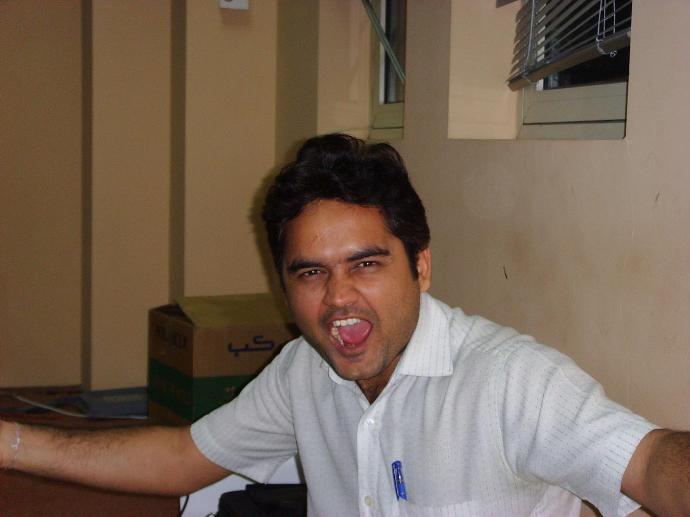
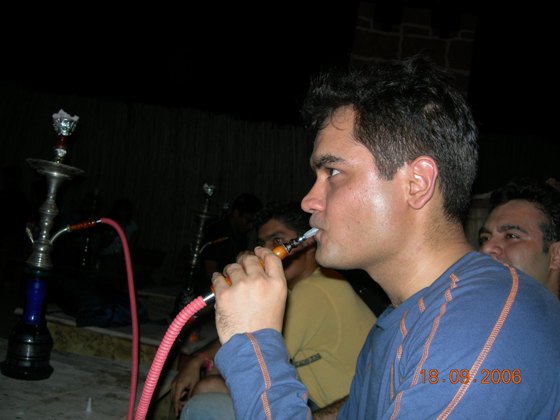
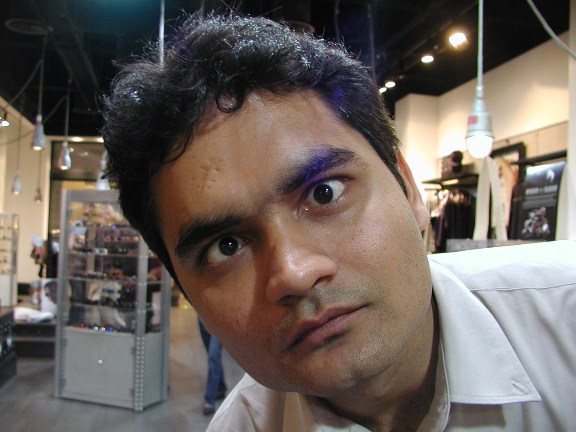
My myriad moods


Kutte Kamine, Main tera khoon Pi jaaonga...


Manoj Kumar ... The thinker!
Deserted...


Smokin!
Flowery times...


Ogle thru goggle ...


Strip but not tease...


Lost in Oakley


Who am I?


Friday, October 13, 2006

Thinking like a Manager

The Indian IT companies may have made the world wake up and notice India but within the company circles there is mass sarcasm that does the rounds. The IT firms have made the word ‘bench’ a byword for ridicule and frustration among the employees. To a victim, it might cast his employer in bad light for lack of projects and demoralize him, making him doubt his own abilities and credentials. Is there a better way of tackling this problem? Is it possible to ameliorate the way a ‘benched’ employee might look at himself and the company? My attempt through this article is to answer this question in the affirmative.

Mr. M Hariharan, our brilliant Cost Accounting professor, discussed a consulting assignment he once worked on. The company in question was a paint manufacturing company. The business model of the company was to produce paints of different colours in bulk and then sell it to wholesalers. The manufacturer wouldn’t sell the paint to anyone needing anything less than 250 kgs of any colour. Shifting production from one colour to another needed a large setup time for cleaning the vessels, removing stains, drying them etc. So he would actually incur some cost in shifting production from one colour to another. So he chose to produce large quantities of a colour in one go rather than shift frequently from one to another.

Think of the problems with this strategy.
• It was cost centric and not customer centric
• Except for wholesalers, not many needed that huge quantity of any single colour
• This stretched inventory turnover as the stocks piled up waiting for a big order
• He lost out on a large number of smaller orders
• Piled up inventory would slowly entail reduced production
• Inflexibility delayed delivery to customer if the colour was not already available

All his problems were solved when he - following our professor’s advice – became more customer centric. He now produced lesser quantities of paints in one go, regularly shifted to different colours and bore the setup cost.

Think of the advantages of this model.
• There was always some amount of any given colour available for sale
• Even if it wasn’t, flexibility ensured that customers’ requirements were met
• Customer was now charged a premium for faster delivery which helped cover setup cost
• The size of the order didn’t matter so he could address all customers’ needs thus increasing his market size
• Inventory turnover was reduced as he was ready to take even the smaller orders

Inventory, as we just saw, is a necessary evil. It gives a cushion of serving an unexpected customer readily and yet becomes a liability once it exceeds a threshold. Crudely put, inventory is to manufacturing what human capital is to IT. The Indian IT companies have always been following a costing model of keeping a safety stock on ‘bench’ and charging the customers for this through overhead costs. Just like the safety stock, the employees on ‘bench’ are very critical to any IT company to overcome any unforeseen exigency. Consider the attrition in the Indian IT companies and this problem would appear even more bothersome. The shadow resource or ‘benched’ employee is thus a conscious choice not only of the vendor but also of the client.

Not many people could’ve taught us Marketing better than Professor Ram kumar did. An IIM Ahmedabad alumnus, he stretched the limit of our thought processes. He made us play a short game while explaining a principle in marketing. He asked us (about 65 of us) to close our eyes and then count from one to twenty individually with only one person speaking at a time. No one was allowed to speak two consecutive numbers. We’d restart if any two students spoke at the same time. With everyone’s eyes closed, no one knew who would speak next; you always felt like speaking next but something would hold you and you would keep quiet and then somebody would speak out the next number after some time. The game was very interesting and after a few days practice we could reach a score of twenty, to our own surprise, amidst cheers of disbelief. So what was the takeaway from this game? Two. First learning has nothing to do with this article and yet is a valuable learning - human beings communicate at the subconscious level. When our goal became the same and grew stronger with every failure, our collective subconsciousness inhibited all but any one person from speaking until we reached our goal. Second learning was a statement that the professor repeated every time we bungled and had to restart the counting. He used to say, “Let us start again. Be patient. Remember that those who are not speaking are contributing equally to our cause.” This was the statement that hit me hard and gave me goose bumps all through this game. I never spoke for the entire game just to experience the thrill of contributing through silence.

So what has that got to do with employees on bench? This game conveys the idea that even without a tangible contribution to the company’s cause, such employees’ contribution is no less than those making a tangible contribution.

Dr. Viktor Frankl, a psychiatrist and founder of Logotherapy and Existential Analysis, in his book “Man’s Search for Meaning,” talks of finding a meaning in any state of life, even in the most sordid ones, to help one live a better life. In the book, he cites an incident where unemployed youth who feel dejected, demoralized and worthless due to their inability to land a job are asked to volunteer for social service until they get a job. After realizing the worth of their voluntary work, these youth realize the meaning of their existence and feel a growing sense of self-worthiness which leads to happiness at best and reduction of inferiority complex at worst.

This is precisely where IT companies have failed. They’ve have failed, not because they keep employees on bench, but because they’ve not effectively communicated the ‘benched’ employee’s worth to the victim himself. This becomes all the more important when, as shown by above examples, an employee’s output is directly related to his sense of self-worthiness, which in turn is associated to the meaning he associates to any state he is in, be it productive or buffer. Keeping the employees motivated is a titanic task for Human Resource Department of any company. They can ill-afford to ignore a threat to motivation which is as glaring as keeping them on 'bench'. This idea should
hence be drilled in their minds during the new joinee's orientation to make their state of mind and self-esteem impervious to 'bench.'

Tuesday, September 05, 2006

Who am I?

I am Kamlesh Acharya. Simple, isn’t it? But am I really the name the world knows me with? I guess not. So? Am I the physical body that moves around various places on earth? Not quite. I think I’m something deeper than the body. Am I the mind? Well, may be. But at times my mind works even when I sleep; do I then say that I’m working? I guess I’m not the mind then. So am I the soul? Well, may be; may be not. While these questions always rustle in my monologues, I don’t quite know how to answer them.

On 4th Aug 2006, Prof Debasis Chatterjee from IIM Lucknow visited SP Jain and took a guest lecture on leadership. While his leadership talk was inspiring, what grabbed the students’ attention most was the high Spiritual Quotient of his speech. He spoke fluently as if reading from a book; being an author of a few books would’ve definitely helped clarify his thought process. He delivered the lecture from his heart and brought the crowd to a mesmerizing introspection through his true words, insightful speech and a high SQ’ed visage to corroborate. Throngs of students just swarmed him after the lecture got over - something I had never seen in any of the previous lectures even when the guests were equally impressive and scholarly in their domain. I believe the difference here was that Prof. Chatterjee managed to touch a chord of our dormant self somewhere and the swarm supported this thought of mine. I was a part of that crowd and a mute spectator. I saw fellow students talking to him, barely able to control tears of joy in their eyes as others simply observed him and gathered the pearls of wisdom that fell from his mouth. I was pleasantly surprised to see so many people impressed with him. Like an avid businessman looking for an opportunity, I realized that the iron is hot and waiting to be struck. So, Dhruv Patel, Kush Bohra and I invited our batch-mates to form an esoteric group of people ready to introspect and look within for answers.

A digression of thought is warranted here. Be it in business or otherwise, isn’t MBA all about finding opportunities for what you want to do and executing your plan when it yields the most?

We roped in Prof. Mala Kapadia - our Human Resource Management professor – to lend authenticity and discipline to the group by forming some ground rules. She was more than happy to oblige. She took our first session and forced us to think deeper and introspect harder. She left us wonderstruck with her simple logical flow of thoughts.

After that session, we’ve had three session conducted by us – the students. We’ve discussed topics like ‘Demystifying God’, ‘True Knowledge’ and ‘Learnings from the Bhagwad Gita on Work.’

Through this group and our meetings, we might not know ‘who we are.’ But by sharing the knowledge with each other, we end up learning a lot from others’ thoughts. Through these sessions, we might not reach the core of true knowledge but we’ve started gnawing at its peripheries for sure.

An interesting incident to end with.

I offered to take the first session of “Who am I?” after Prof. Mala. I called my session “Demystifying God” and sent a mail across to the group. An eager beaver I met thereafter told me that he found the topic really interesting and wondered what I’m going to talk about. I told him to wait and watch. The impatient guy that he was, he told he would search for it. Before I reveal my reply, a small digression to surprise you is not uncalled for.

Our Marketing Management professor Mr. Ramkumar told us some statistical facts released by Google.

From within India, the most searched word on Google last year was ‘S**.’
From within the US, the most searched word on Google last year was ‘God.’

I told the edgy friend, ‘You can’t search God on Google.’
*************************************
P.S. One of the subjects that is setting tongues wagging at Harvard Business School is also on the same lines. Isn't it wonderful that what is taught by professors there at Harvard is a student initiative here at SP Jain? Check out.